




Patients searching for a malleable penile implant in India often compare two international devices:
Promedon TUBE and Rigicon Rigi10.
You may also see these searched online as “Promedon Tube vs RigiTen”, “Promedon vs Rigicon”, or even voice-search variations of these names.
I perform a high volume of penile implant surgery, and I believe patients should compare these devices on engineering, regulatory approval, published evidence, fracture risk, sizing, coating, concealability, warranty and international use—not simply on which implant is promoted more aggressively.
Important Disclosure
I want to be completely transparent before making this comparison.
I am not paid by Rigicon to write this article.
However, I use Rigicon implants extensively in my clinical practice, and I was one of the authors of the original international publication evaluating the first Rigi10 malleable penile prostheses worldwide.
That study included 605 patients implanted by 46 physicians across 15 countries. My name appears as one of the authors, and the publication declared no competing financial interest for me.
So the reader should know that I have substantial first-hand experience with Rigi10.
The purpose of this page is therefore not to pretend that I have no experience or preference. It is to put the verifiable specifications and published evidence side by side so that patients can make an informed decision.
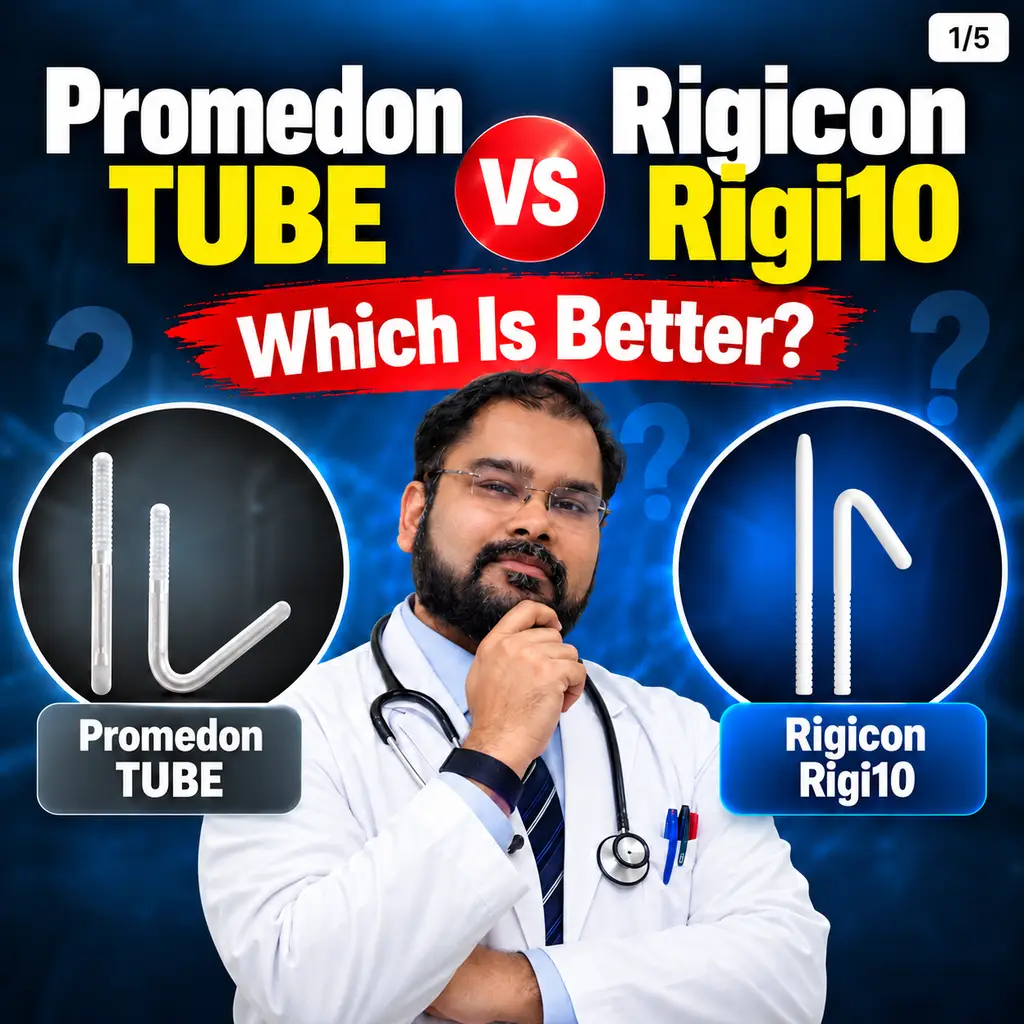
Promedon TUBE vs Rigi10: Quick Comparison
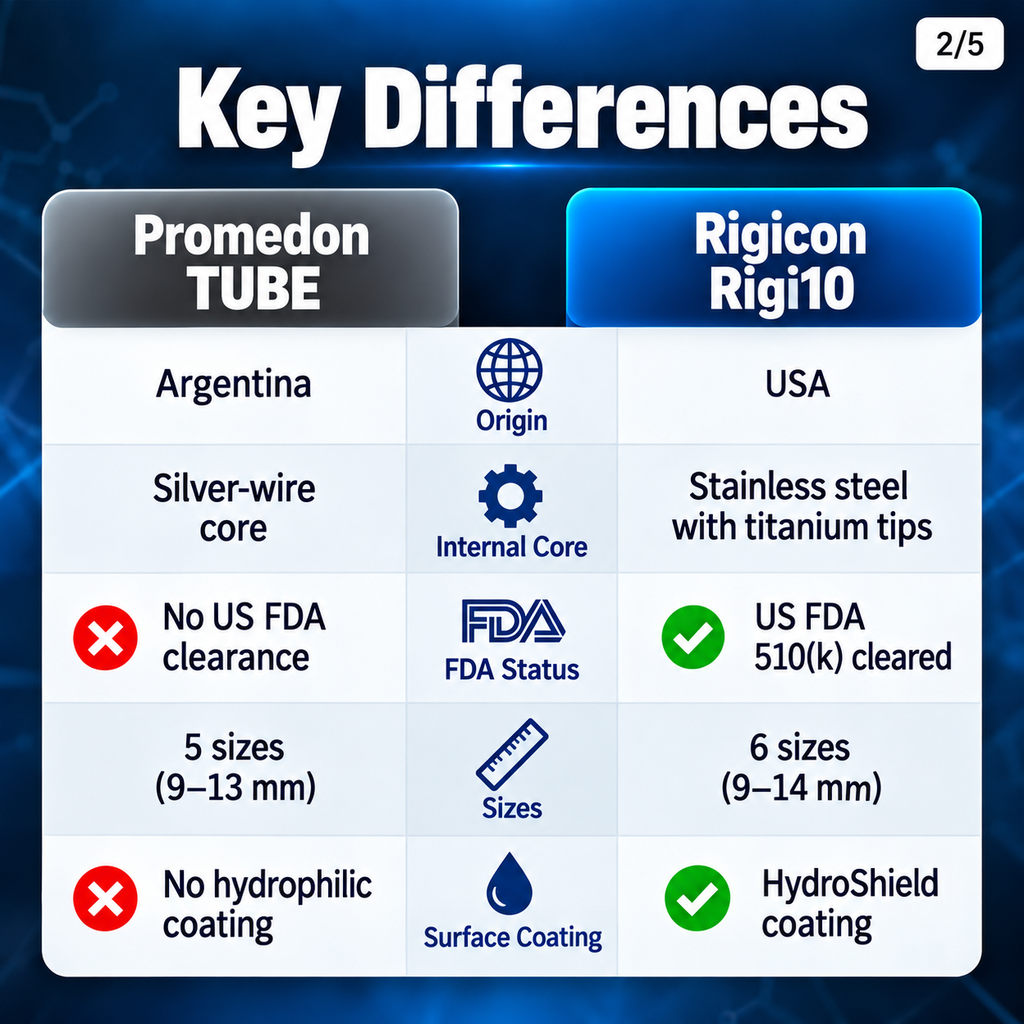
| Feature | Rigicon Rigi10 | Promedon TUBE |
|---|---|---|
| Company origin | Rigicon Inc., USA | Promedon S.A., Argentina |
| Internal core | Twisted stainless-steel core with titanium end caps | Twisted silver-wire core |
| US FDA status | FDA 510(k) cleared – K181673 | No US FDA 510(k) clearance for TUBE |
| US availability | Yes – commercially available in 9–13 mm sizes | No current US commercial TUBE presence |
| European regulatory labeling | CE mark shown in current Rigi10 labeling | Current TUBE manufacturer materials reviewed do not display a TUBE-specific CE/MDR certification |
| Published global study | 605 patients, 46 surgeons, 15 countries | No comparable large contemporary multinational TUBE study |
| Diameters available | 9, 10, 11, 12, 13, 14 mm – six sizes | 9, 10, 11, 12, 13 mm – five sizes |
| Surface coating | HydroShield hydrophilic coating | No comparable hydrophilic coating described |
| Antibiotic dipping | Hydrophilic coating allows surgeon-selected aqueous/antibiotic dipping | No equivalent coating feature described |
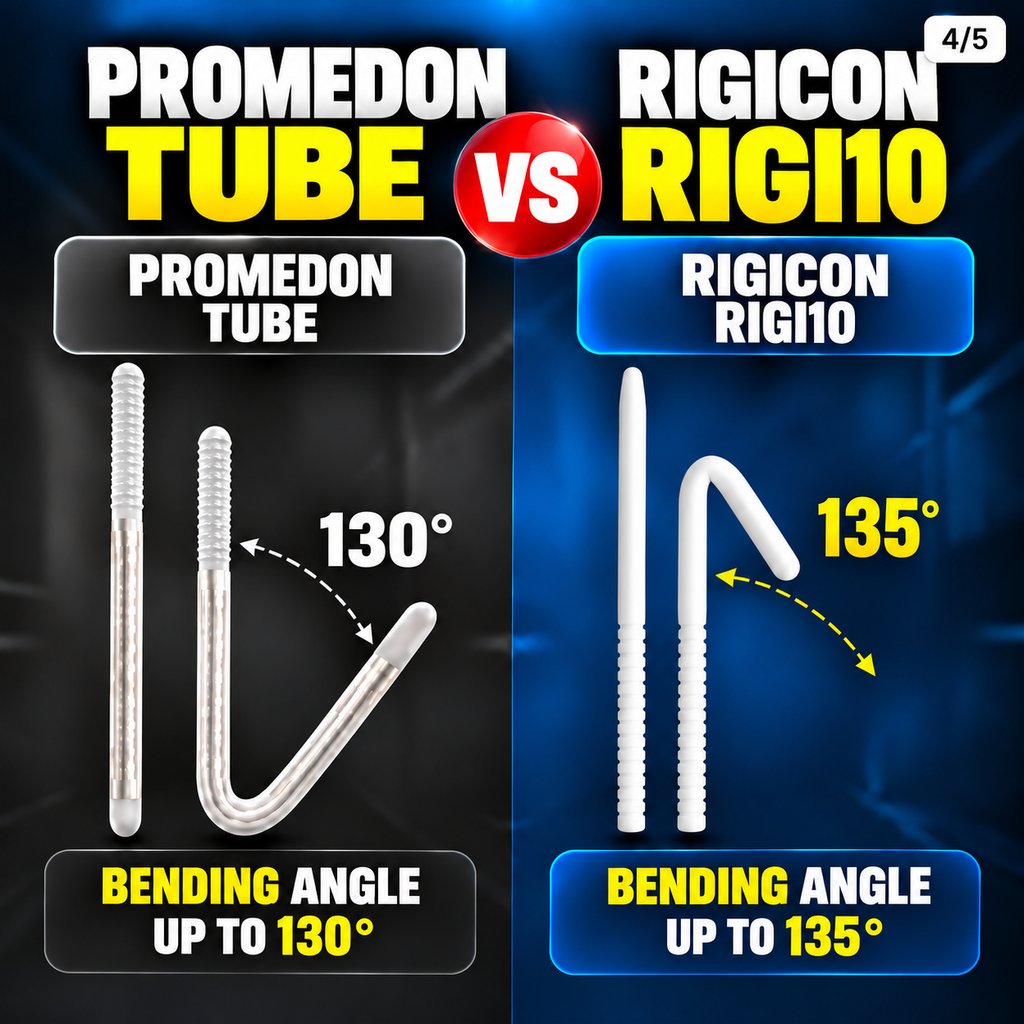
| Bending angle | Up to 135° | 130° |
| Fatigue testing | Manufacturer reports repeated bending-cycle testing; 50,000 cycles is manufacturer bench data | No comparable modern published manufacturer cycle count shown |
| Axial rigidity | Manufacturer reports high column strength; published company material describes stainless-steel/titanium construction | >1.5 kg axial load per rod – manufacturer claim |
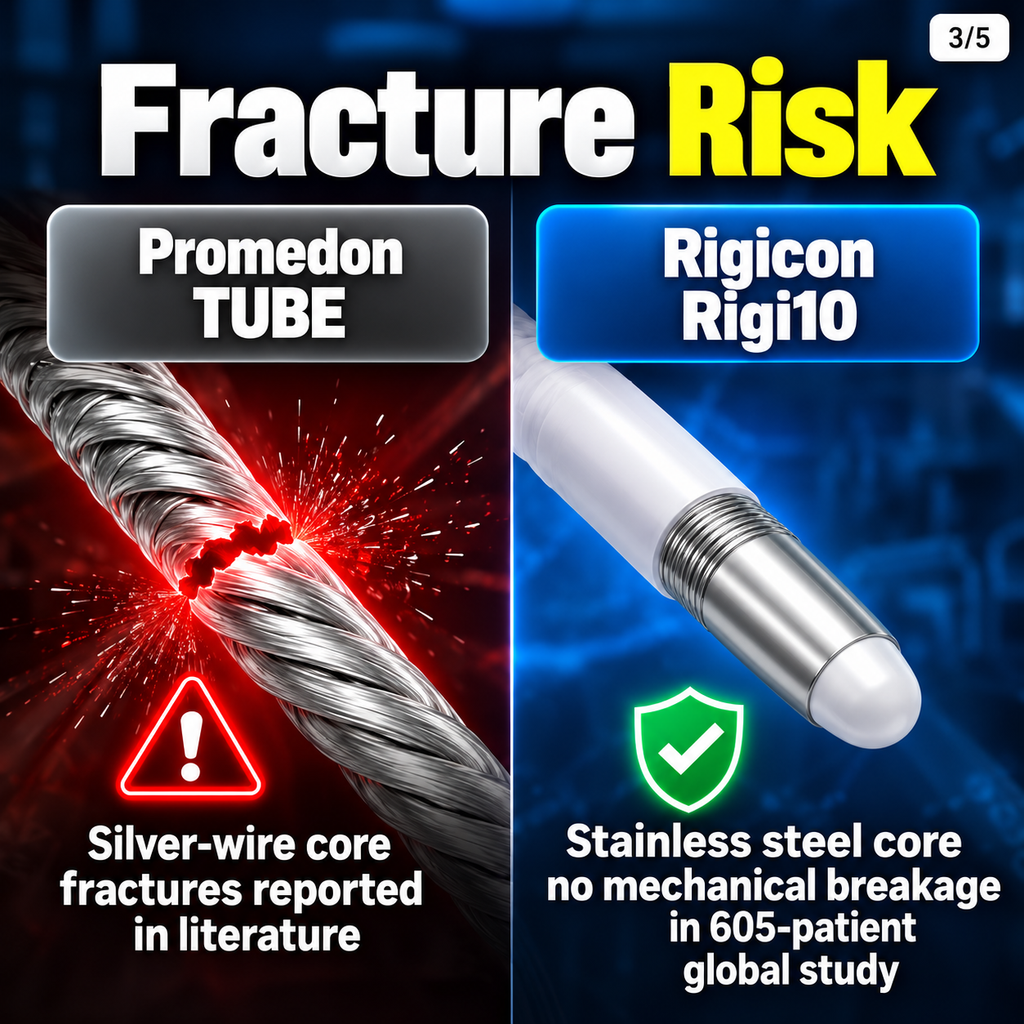
| Published mechanical fracture | No mechanical breakage in the initial 605-patient study | Silver-wire fractures documented in published clinical literature |
| Manufacturer warning about repeated bending | Designed for repeated repositioning/concealability | Promedon patient guide specifically cautions against repeated up/down bending because the prosthesis may lose rigidity or break |
| Distal tip | Soft-touch; conical in 9–10 mm, rounded in larger commonly used sizes | Soft rounded distal tip |
| Rear-tip extenders | 0.5 cm and 1 cm extenders supplied | 10 mm and 15 mm rear-tip extenders supplied |
| MRI | MR Conditional at 1.5T and 3T | MR Conditional at 1.5T and 3T |
| Airport security | Contains metal; may or may not trigger screening depending on detector | Contains silver metal; may or may not trigger screening depending on detector |
| Airport advantage | Tie | Tie |
| Warranty | Product Replacement Lifetime Warranty, subject to local terms | 5-year replacement warranty for qualifying manufacturing defects |
| Biggest unanswered question | Long-term 10–15-year durability still needs more time | Long-term silver-wire fatigue/fracture is already documented |
Rigi10’s US FDA clearance is publicly listed under K181673, with Rigicon Inc. as the applicant. The FDA describes the device as containing a malleable stainless-steel core with titanium caps, PTFE covering and silicone outer surface.
Promedon itself describes TUBE as containing a twisted silver-wire core, quotes more than 1.5 kg axial load per hemi-prosthesis, 130° malleability, diameters from 9 to 13 mm and a five-year warranty.
1. My Biggest Concern: Fracture
This is the first difference I discuss with patients.
Promedon TUBE uses a twisted silver-wire core.
That matters because silver-wire fracture is not theoretical. It has a long history in penile prosthesis engineering, and fractures have also been reported specifically with Promedon TUBE.
Even more importantly, Promedon’s own patient guide advises patients to avoid repeatedly bending the prosthesis up and down, repeated vibration and significant trauma because under such conditions the implant may lose rigidity or break.
For me, this warning deserves attention.
A malleable implant is specifically designed to be moved:
down for concealment → up for intercourse → down again afterwards.
That movement may occur thousands of times during the lifetime of the implant.
So the clinically important question is not merely:
“Is the implant hard enough today?”
It is:
“What happens to the internal metal core after years of repeated bending?”
Rigi10 uses a stainless-steel wire core with titanium end caps rather than a silver-wire core. Its FDA submission included simulated life/fatigue, buckling and concealability testing.
The main published international Rigi10 study followed 605 first-time implant patients and reported no mechanical breakage during the available follow-up period.
That does not prove that Rigi10 can never fracture.
It does mean that, so far, its published contemporary clinical dataset has not demonstrated the silver-wire fracture pattern already documented with TUBE.
2. What About Hardness and Axial Rigidity?
This is another area where patients hear very strong claims.
Promedon advertises:
more than 1.5 kg axial load per rod without bending.
That demonstrates adequate rigidity for intercourse.
But it does not prove Promedon is the most rigid implant available.
Rigi10’s manufacturer describes its stainless-steel core reinforced by titanium caps as providing the column strength needed for penetration. Its manufacturer bench material also reports substantial axial rigidity and repeated simulated fatigue testing.
The important limitation is that these numbers are manufacturer bench tests, not an independent randomized comparison performed on the same testing machine.
So I would not tell a patient:
“Promedon is definitely hardest.”
Nor would I say:
“Rigi10 is definitely hardest.”
The correct conclusion is:
Both are designed to provide enough rigidity for intercourse.
But durability after repeated bending is a separate engineering question—and that is where core construction becomes more important.
3. Fatigue Testing: Bending Once is Not The Same as Bending For Years
This is why fatigue-cycle testing matters.
Rigi10 is designed to bend from a straight position to a concealed position repeatedly.
Rigicon’s manufacturer data describes repeated 0° to 90° bending cycles without mechanical failure, and manufacturer-distributed bench data reports testing of the 9-mm configuration to 50,000 bending cycles.
That is a bench test, not 50,000 actual patient movements.
But it is still relevant engineering information.
With Promedon, I have not found an equivalent contemporary manufacturer bending-cycle number.
Instead, the manufacturer’s own patient guide warns patients about repeated up/down bending and possible loss of rigidity or breakage.
That difference is difficult for me to ignore.
4. FDA Clearance and International Regulatory Footprint
Rigi10 received US FDA 510(k) clearance in April 2019.
It is currently sold commercially in the United States in:
- 9 mm
- 10 mm
- 11 mm
- 12 mm
- 13 mm
The 14-mm version is available internationally but is not currently sold in the USA.
The Rigi10 labeling also displays the CE mark and identifies an EU authorized representative in the Netherlands.
For Promedon TUBE, there is no US FDA 510(k) clearance for the TUBE penile prosthesis.
Promedon is an international company and TUBE is used in several countries, particularly in Latin America and markets outside the United States.
But the current Promedon TUBE product material I reviewed does not display a TUBE-specific CE/MDR certification claim.
This does not automatically mean one implant works and another does not.
But these are real regulatory differences that patients should know.
5. International Surgeon Use and Published Evidence
This is another important difference.
The first major Rigi10 safety study involved:
- 605 patients
- 46 implanting physicians
- 15 countries
The authors included surgeons affiliated with centres in the United States, Turkey, Jordan and India, including Mayo Clinic, University of South Florida, Duke University, University of California Irvine and other specialist centres.
The implant was used by 46 high-volume experienced implanters across those countries.
That gives Rigi10 a genuinely multinational contemporary clinical dataset.
Promedon TUBE does have published literature.
However, I do not see an equivalent recent TUBE-specific multinational dataset documenting hundreds of patients across dozens of surgeons and 15 countries.
That is different from saying nobody uses Promedon internationally.
They do.
But when an Indian patient asks me about the strength of the modern international evidence base, I consider the Rigi10 dataset broader.
6. Hydrophilic Coating: A Genuine Engineering Difference
Rigi10 has HydroShield hydrophilic coating.
This is not the same as saying the implant contains a permanent antibiotic.
The hydrophilic coating allows the surgeon to use a preferred aqueous or antibiotic solution before implantation.
That is useful because penile prosthesis infection is one of the complications surgeons work hardest to prevent.
Promedon TUBE’s current technical material does not describe a comparable hydrophilic coating.
For me, that is a meaningful difference rather than a marketing detail.
7. Size Options: 6 Diameters vs 5
Rigi10 is available in:
9, 10, 11, 12, 13 and 14 mm
—six diameter choices.
Promedon TUBE is available in:
9, 10, 11, 12 and 13 mm
—five diameter choices.
Why does this matter?
Because corpora are not manufactured in standard sizes.
One patient may fit an 11-mm rod comfortably, another may genuinely be better suited to 12 mm.
The additional 14-mm option may also be useful in selected larger corpora.
More size choices give the surgeon more ability to match the patient’s anatomy rather than forcing the anatomy to match the implant.
8. Concealability and Bending
Rigi10 is specified to bend up to 135° and is designed with low spring-back for concealment.
Promedon quotes 130° malleability.
Five degrees by itself probably does not determine which implant a patient should select.
More important is how easily the implant bends, how well it remains in the concealed position and how repeated bending affects its mechanical lifespan.
So I would call the bending-angle numbers fairly close.
The bigger engineering difference remains the internal stainless-steel versus twisted silver-wire architecture.
9. MRI: Effectively a Tie
Both devices are MR Conditional.
Rigi10 is approved by its manufacturer for scanning under specified conditions at 1.5 Tesla and 3 Tesla.
Promedon also publishes a specific TUBE MR Conditional statement for 1.5T and 3T, including defined SAR and field-gradient limits.
So I would not claim an MRI advantage for either implant.
MRI: Tie.
Patients should always inform the radiology team that they have a penile prosthesis and follow the specific manufacturer’s MRI conditions.
READ ALSO
- Andropenis PRO vs RestoreX for Peyronie’s Disease
- 6 Most Common Penile Implant Questions Answered
- Penis Fracture Treatment in India
- Penile Implant Surgery Procedure in Delhi
10. Will Rigi10 Beep at Airport Security?
This argument is sometimes used against stainless-steel penile implants.
It sounds dramatic, but the science is much less dramatic.
Rigi10 contains stainless steel.
Promedon contains silver wire.
Both contain metal.
Airport walk-through and handheld metal detectors are designed to detect different metallic materials, including non-ferrous metals—not merely steel. European aviation standards specifically require detection of different metals, while UK guidance states that handheld airport detectors should detect both ferrous and non-ferrous metallic objects.
Modern full-body scanners can also identify metallic and non-metallic anomalies.
Therefore:
A stainless-steel Rigi10 may trigger some security systems.
A silver-core Promedon may also trigger some security systems.
Neither implant can honestly be guaranteed to “never beep.”
And airport screening does not mean the implant is damaged.
Patients with implants can simply explain that they have a medical device and carry their implant card.
Airport security: Tie.
I would not choose a permanent penile implant based on an airport metal-detector argument.
11. Warranty
This difference is much more meaningful.
Rigicon offers a Product Replacement Lifetime Warranty for Rigi10 where available, subject to country-specific terms. It covers qualifying device replacement but does not automatically cover hospital, surgeon, anesthesia or revision-surgery expenses.
Promedon’s current global TUBE warranty is:
5 years
and replacement applies when the malfunction is determined to arise from a manufacturing defect.
So on manufacturer’s device-replacement warranty:
Rigi10: Lifetime
Promedon TUBE: 5 years
That is a clear difference.
What Are the Disadvantages of Rigi10?
A fair comparison should also say where Rigi10 still has unanswered questions.
★ It is a Newer Implant
TUBE has existed for longer.
Rigi10 therefore does not yet have 15- or 20-year patient follow-up.
★ Its Main Multinational Paper is An Early Safety Study
The 605-patient study used manufacturer patient-information forms and had a mean follow-up of approximately 21.6 months.
That is useful real-world data, but it is not equivalent to a 10-year independent randomized trial.
★ Manufacturer Bench Tests Are still Manufacturer Tests
The fatigue and rigidity figures should be treated as engineering bench claims unless independently reproduced.
I apply the same standard to Promedon’s >1.5-kg axial-rigidity claim.
VISIT OUR MEN’S HEALTH WEBSITE

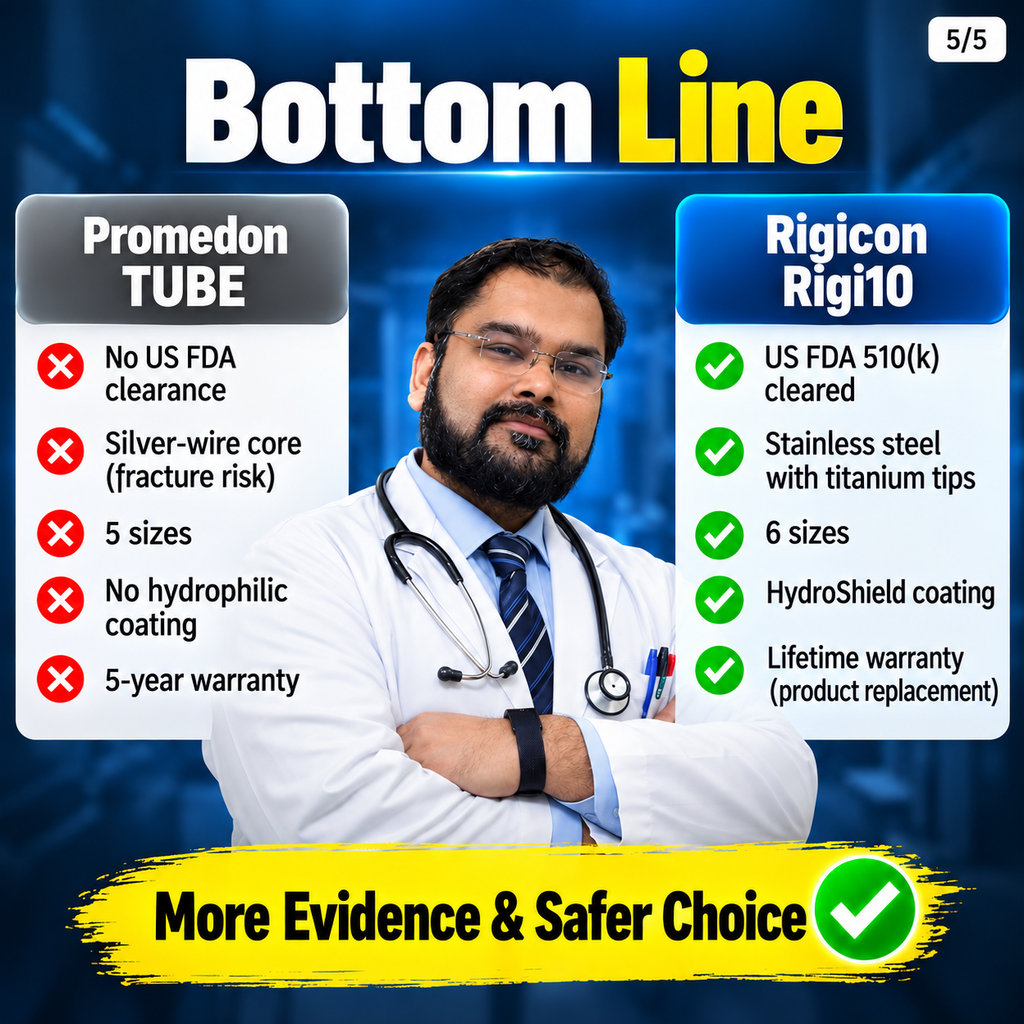
My Conclusion
When patients ask me to compare Promedon TUBE vs Rigicon Rigi10, I do not think the most useful question is:
“Which implant is harder?”
The differences that matter more to me are:
★ Core Design
Rigi10: stainless steel with titanium end caps.
Promedon: twisted silver wire.
★ Fracture Concern
Promedon has documented silver-wire fracture literature and its own patient guide cautions against repeated bending because loss of rigidity or breakage may occur.
★ Regulatory Footprint
Rigi10 has US FDA 510(k) clearance and current US commercial availability.
★ Hydrophilic Coating
Rigi10 has HydroShield; TUBE does not advertise an equivalent coating.
★ Sizing
Rigi10 offers six diameters from 9–14 mm; Promedon offers five from 9–13 mm.
★ Modern Multinational Evidence
Rigi10 has published data from 605 patients, 46 surgeons and 15 countries.
★ MRI
Tie.
★ Airport Metal Detectors
Tie. Both contain metal.
★ Warranty
Rigi10: lifetime product-replacement warranty where applicable.
Promedon TUBE: five years.
For me, the most important difference remains durability of the internal core.
A malleable implant is supposed to be bent repeatedly during daily life.
So before choosing any implant, I would ask:
“What is inside this implant, and what evidence do we have about what happens to that core after thousands of bends?”
That question is more important than any advertisement.
Reference
The study included 605 patients, 46 physicians and 15 countries and reported a three-year estimated freedom from revision of 99.2%.
Medical disclaimer: This article is for patient education. Choice of penile prosthesis should be individualized according to corporal anatomy, fibrosis, infection risk, surgeon experience, available device sizes, regulatory availability and patient preference. Manufacturer specifications and warranty terms may change and should be verified at the time of surgery.
